|
|
My husband and I live in Phoenix, but we visited San Antonio this past weekend, and had dinner at a restaurant along the River Walk. It was a nice restaurant with an open patio. I had a sweater with me, as temperatures were brisk. I didn’t notice that the sweater had fallen to the floor while I ate and talked with friends. Afterward, on leaving the restaurant, I put the sweater over my arms and we drove to another place. Soon afterward I noticed that my right forearm, near my elbow, began to burn and become painful… [...]
These insects are fearsome looking, in both the larval and mature stages. The male fly is particularly terrifying in appearance due to its enormous jaws that stretch outward from the face a distance nearly half as long as its body. The mature female’s jaws, by comparison,are relatively short, no longer than the head, though they — like those of the larva but unlike the jaws of the mature male, which are used strictly to hold the female during, as Howard (1914) put it, the marital caress — are capable of delivering a severe pinch to a human careless enough to place an appendage within their range of motion. Even then, however, the pinch is of no medical consequence, as it is scarcely capable of tearing human skin and in any case is not supplied with venom. [...]
On Thursday, 10 May 2012, at a large retirement community in Temple, Texas, I picked up two large beetles that had been saved for me by the Director of Facilities. One measured about 1.75 inches in length, and the other was slightly smaller. On the anterior dorsum of the body (the pronotum) of each of these specimens were two large black spots — that looked much like eyes — outlined on their perimeters with cream-colored scales; a second set of more vaguely outlined eye-spots were on the elytra. These beetles… [...]
The generic name, Plectrodera, derives from the Greek πληκτρον, plectron, “spear-point”, in combination with the Greek δειρη, dera or deira, “neck, throat, collar”, which together refer to the prominent spines on the lateral surfaces of its neck. The specific name, scalator, is derived from the Latin scalas, “a ladder, stairs, staircase” in combination with the Greek suffix τορ, tor, which–along with a number of similar suffixes–indicate an agent or doer, but is often used for animals that bore in wood and other substrates; the combination, scalator, is a reference to the peculiar behavior of this beetle, both in the way its larvae bore into the wood of cottonwood trees, and in the way the mature females deposit their eggs. [...]
The sphinx moths are a subset of the Spingidae family, which includes hawk moths amd sphinx moths. Among these are the hummingbird moths, which are hawk moths that, like hummingbirds and certain bats, have evolved the ability to hover in a very precise position while inserting their proboscis deep into a flower’s nectary to extract its nectar… [...]
The milkweed assassin bug is a member of the order Hemiptera (the true bugs); the suborder Heteroptera (with hardened elytra, or wing coverings, over membranous wings); the infraorder Cimicomorpha (a subset of the Heteroptera comprising assassin bugs, plant bugs, lace bugs, damsel bugs, minute pirate bugs, and bed bugs); the family Reduviidae (named for the genus Reduvius “hangnail or remnant,” a large, cosmopolitan family of predatory Heteroptera that includes the assassin bugs, wheel bugs, and thread-legged bugs); the subfamily Harpactorinae (the assassin bugs,.. [...]
The spiny oak slug (Euclea delphinii) is the larva (caterpillar) of a limacodid moth. The North American variant of this moth is mostly dark brown, with a conspicuous triangular green patch on the median portion of the upper wing. The larva has a bright green — in today’s parlance, many would likely call it “neon green” — body with two longitudinal pale green, orange, or red stripes. These stripes are adorned with a series of spiny tubercles. Additional spiny tubercles adorn the peripheral body. The spines on the tubercles… [...]
Several picture-winged flies native to North America are commonly confused with fruit flies. Were they comparable, in terms of biology and habitat, that would not bode well for the picture-winged flies, as fruit flies deposit their eggs in living, healthy plant tissue and their larvae live and feed on the host plant. By contrast, the larvae of most species of picture-winged flies (today classified under the family Ulidiidae) are saprophagic, that is, they feed on dead, decaying tissue… [...]
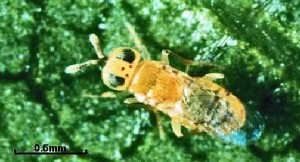
This tiny parasitic wasp is a member of the Chalcidoidea superfamily, which is now–along with many if not most taxonomical groupings–under constant revision as more is learned about the underlying molecular systematics. The Chalcidoidea is presently subdivided into nineteen families, including the Encyrtidae, within which the subject species is currently grouped [...]
Before you stretch the placid waters of Lake Conroe, a large, inland, freshwater lake in southeast Texas. It is a warm, sunny day, and the breeze smells sweet. You’re ready — to the point of excited impatience — to take your watercraft out for a spin on the water. Years ago, after much research and leg work, you carefully chose Walden Marina, one of seven Flagship Marinas in the United States, as the place on Lake Conroe to berth your boat. To you, the waterways are more than a source of recreation; they’re also a precious natural resource. Like most boaters, you do your part to protect them, and you knew that Allison Harpold, the conscientious, hard-working manager at Walden Marina, does everything in her power to make it as clean and green as possible. [...]
|
|