Categories

Puss Caterpillar Stings Visitor to San Antonio River Walk

My husband and I live in Phoenix, but we visited San Antonio this past weekend, and had dinner at a restaurant along the River Walk. It was a nice restaurant with an open patio. I had a sweater with me, as temperatures were brisk. I didn’t notice that the sweater had fallen to the floor while I ate and talked with friends. Afterward, on leaving the restaurant, I put the sweater over my arms and we drove to another place. Soon afterward I noticed that my right forearm, near my elbow, began to burn and become painful… [...]

A Tersa Sphinx Moth Larva from League City, Texas

The sphinx moths are a subset of the Spingidae family, which includes hawk moths amd sphinx moths. Among these are the hummingbird moths, which are hawk moths that, like hummingbirds and certain bats, have evolved the ability to hover in a very precise position while inserting their proboscis deep into a flower’s nectary to extract its nectar… [...]

A Milkweed Assassin Bug from League City, Texas

The milkweed assassin bug is a member of the order Hemiptera (the true bugs); the suborder Heteroptera (with hardened elytra, or wing coverings, over membranous wings); the infraorder Cimicomorpha (a subset of the Heteroptera comprising assassin bugs, plant bugs, lace bugs, damsel bugs, minute pirate bugs, and bed bugs); the family Reduviidae (named for the genus Reduvius “hangnail or remnant,” a large, cosmopolitan family of predatory Heteroptera that includes the assassin bugs, wheel bugs, and thread-legged bugs); the subfamily Harpactorinae (the assassin bugs,.. [...]

Spiny Oak Slugs from the Texas Cities of Cedar Creek and League City

The spiny oak slug (Euclea delphinii) is the larva (caterpillar) of a limacodid moth. The North American variant of this moth is mostly dark brown, with a conspicuous triangular green patch on the median portion of the upper wing. The larva has a bright green — in today’s parlance, many would likely call it “neon green” — body with two longitudinal pale green, orange, or red stripes. These stripes are adorned with a series of spiny tubercles. Additional spiny tubercles adorn the peripheral body. The spines on the tubercles… [...]

A Picture-winged fly from League City, Texas

Picture-Winged Fly (Delphinia picta); Mark Turvey, Humble, TX--3 Nov 2010

Several picture-winged flies native to North America are commonly confused with fruit flies. Were they comparable, in terms of biology and habitat, that would not bode well for the picture-winged flies, as fruit flies deposit their eggs in living, healthy plant tissue and their larvae live and feed on the host plant. By contrast, the larvae of most species of picture-winged flies (today classified under the family Ulidiidae) are saprophagic, that is, they feed on dead, decaying tissue… [...]

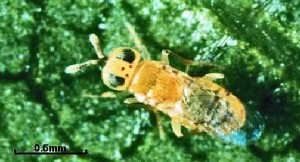
The Grape Mealybug Parasitoid (Pseudaphycus angelicus)

This tiny parasitic wasp is a member of the Chalcidoidea superfamily, which is now–along with many if not most taxonomical groupings–under constant revision as more is learned about the underlying molecular systematics. The Chalcidoidea is presently subdivided into nineteen families, including the Encyrtidae, within which the subject species is currently grouped [...]

Lake Midges & Longjawed Orb Weavers at Walden Marina, Lake Conroe (Montgomery, Texas)

Before you stretch the placid waters of Lake Conroe, a large, inland, freshwater lake in southeast Texas. It is a warm, sunny day, and the breeze smells sweet. You’re ready — to the point of excited impatience — to take your watercraft out for a spin on the water. Years ago, after much research and leg work, you carefully chose Walden Marina, one of seven Flagship Marinas in the United States, as the place on Lake Conroe to berth your boat. To you, the waterways are more than a source of recreation; they’re also a precious natural resource. Like most boaters, you do your part to protect them, and you knew that Allison Harpold, the conscientious, hard-working manager at Walden Marina, does everything in her power to make it as clean and green as possible. [...]

Africanized European Honey Bees in East-central Austin, Texas

Back in 1957, some 26 queens from a subspecies (Apis mellifera scutellata) of African honey bees native to the African nation of Tanzania, were accidentally–or, according to some researchers, intentionally–released in southeast Brazil following research by the biologist Warwick E. Kerr into the behavior of such bees in the forests of tropical South America. It was widely believed at the time that such bees would produce more honey and survive better than the European honey bees then being imported throughout the Americas for use in crop pollination and honey production. [...]

Acrobat Ants in Temple, Texas

Every spring, throughout Texas and most of the southern half of the U.S., soon after new growth erupts from leaf buds, the acrobat ants sally forth from their winter nests. Then, depending on whether or not they cultivated a winter population of mealybugs or aphids in their nests, they either begin herding that extant population, or begin to seek out external populations of local mealybugs and aphids to domesticate. [...]

A Male Jumping Spider in Lufkin, Texas

The salticids are distinctive, with a huge pair of anterior median eyes (AME) in the midst of the face. Except for the translucent green Magnolia Green Jumper (Lyssomanes viridis), all North American jumpers have AME that are flanked, laterally, by much smaller–though still large by most standards–anterior lateral eyes (ALE), as shown in Julia’s specimen. [...]